
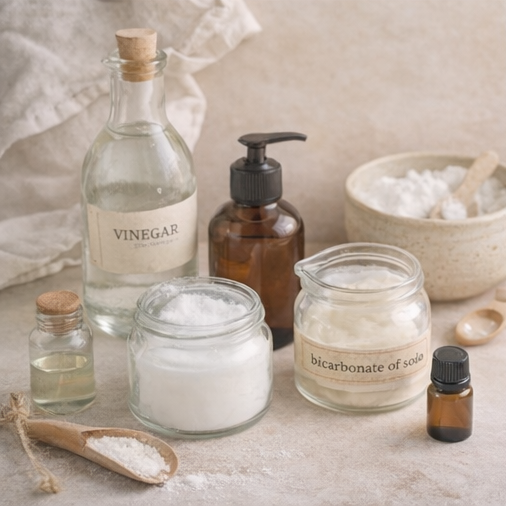
And What I Make With Them
If you strip things back, you don’t need much to make effective, low-tox products at If you strip things back, you don’t need much to make effective, low-tox products at home.
I used to have a cupboard full of single-purpose products — one spray for the kitchen, one for the bathroom, one for the glass, a separate one for the floor. Each with its own long ingredient list and its own plastic bottle to eventually throw away.
Gradually, I replaced them. Not all at once, and not out of some dramatic lifestyle overhaul — just quietly, one swap at a time, as I learned what actually worked. What I’ve ended up with is a small collection of versatile ingredients that between them cover almost every household need.
It’s not about rejecting modern life. It’s about reducing unnecessary complexity and bringing things back within your control.
Here’s what I keep stocked — and what I make with each one.
The Staples
White Vinegar
The most underrated cleaning ingredient in existence. White vinegar is naturally antibacterial, cuts through grease, and leaves glass streak-free. The smell disappears quickly once dry — it’s far less lingering than most people expect.
I use it for: my kitchen surface spray, cleaning glass and mirrors, descaling the kettle, and as a fabric softener alternative in the washing machine.
Important: do not use vinegar on marble or granite surfaces — the acid can damage the stone.
Bicarbonate of Soda
A gentle abrasive and natural deodoriser. It neutralises odours rather than masking them, which makes it useful in far more places than just baking.
I use it for: my natural deodorant, surface scrubs for sinks and hobs, deodorising the fridge and bins, and freshening carpets before hoovering.
Washing Soda
Often confused with bicarbonate of soda but considerably stronger. Washing soda (sodium carbonate) is highly alkaline and brilliant for cutting through grease and stains. Handle with gloves — it can irritate skin with prolonged contact.
I use it for: homemade laundry powder, soaking grimy oven trays, and as a heavy-duty cleaner for particularly stubborn surfaces.
Castile Soap
A plant-based liquid soap made from vegetable oils — traditionally olive oil, though most versions today are a blend. It’s concentrated, biodegradable, and incredibly versatile. A little goes a very long way.
I use it for: homemade hand wash, a gentle all-purpose surface spray (on stone surfaces where vinegar isn’t suitable), washing up, and as a base for a gentle floor cleaner.
Important: never mix castile soap and vinegar in the same bottle — the acid and soap cancel each other out and you’ll be left with an oily, ineffective mess.
Coconut Oil
The crossover ingredient between the kitchen shelf and the natural homemaking shelf. Coconut oil has natural antibacterial properties thanks to its lauric acid content, making it genuinely effective in body care formulations.
I use it for: my natural deodorant, as a makeup remover, a simple body moisturiser, and in baking. One jar, many uses.
Beeswax or Soy Wax Pellets
Both earn their place depending on what you’re making. Soy wax pellets are my go-to for candles — they burn cleaner and cooler than paraffin and hold essential oil scent beautifully. Beeswax has a higher melting point and is better for solid products like lip balms or furniture polish.
I use them for: natural soy candles (my post on candle making has the full recipe), homemade lip balm, and beeswax wood polish.
Essential Oils
Not just for scent — many essential oils have genuinely useful properties that make them worth keeping for both cleaning and body care. The four I use most are:
- Lavender — calming, antibacterial, and one of the safest oils to use undiluted in a pinch. Into deodorant, surface spray, and the diffuser.
- Lemon — fresh, uplifting, and a natural antiseptic. Brilliant in kitchen cleaning products.
- Eucalyptus — antibacterial and antifungal. Good for bathroom sprays and in a diffuser during cold season.
- Tea tree — one of the most effective natural antibacterials available. Into deodorant, surface spray, and homemade hand wash.
Always be cautious with essential oils around young children and pets — some oils are not safe for them at certain concentrations. Check before using.
Glass Bottles, Spray Bottles & Saved Jars
Perhaps the most Modern Homemaking item on the list. I keep a small collection of glass spray bottles, old cosmetic pots, and clean jam jars. They store homemade products beautifully, nothing goes to waste, and there’s a genuine satisfaction in decanting your own surface spray into a reusable bottle.
I use them for: storing surface cleaner, natural deodorant, hand wash, candles, and any other homemade product. Glass is preferable to plastic for anything containing essential oils, as the oils can degrade certain plastics over time.
What You Can Make From These Eight Ingredients
With these staples on hand, here’s what’s within reach:
- Natural kitchen surface spray (vinegar + water + essential oils)
- Gentle all-purpose spray for stone surfaces (castile soap + water)
- Natural deodorant (coconut oil + shea butter + bicarbonate of soda + essential oils)
- Homemade hand wash (castile soap + water + essential oils)
- Natural soy candles (soy wax + wood wick + essential oils)
- Homemade laundry powder (washing soda + bicarbonate of soda + castile soap)
- Sink and hob scrub (bicarbonate of soda + castile soap)
- Diffuser blends (essential oils + water)
Most of these take under ten minutes to make and cost a fraction of their shop-bought equivalents.
Start With One Swap
You don’t need to overhaul everything at once. Pick one product you currently buy and try making it instead. A surface spray is the easiest place to start — it takes two minutes and the ingredients cost less than a pound.
If you’re just getting started, my natural surface cleaner post and natural deodorant recipe both use ingredients from this list and are good first projects. The candle-making post is worth a read too if you’re curious about taking it a little further.
From these few ingredients, you really can cover most household needs. No complicated formulas. No endless shopping. Just simple, adaptable basics — and the quiet satisfaction of knowing exactly what’s in everything you use.
— Harper
Leave a Reply