
And Why I Stopped Using Sprays
I didn’t set out to become someone who makes their own deodorant.
Like most people, I bought sprays because they were there — brightly packaged, heavily fragranced, promising protection and confidence in a can. But the more I read, the harder it became to ignore what those sprays actually contain. Propellants. Synthetic fragrances. Ingredients linked to hormone disruption and respiratory irritation. And all of it being sprayed, daily, near lymph nodes and lungs.
It felt… unnecessary.
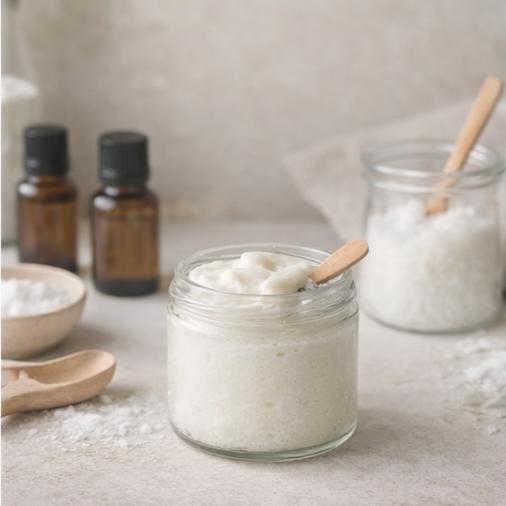
What struck me most was how far we’ve drifted from the basics. We’re sold products designed to solve problems we’ve been told we have — when in reality, simple formulations often work just as well. A natural deodorant made with coconut oil, bicarbonate of soda, and essential oils won’t stop you from sweating, and it shouldn’t. But it does neutralise odour and supports the body rather than overriding it.
And here’s the important part: this doesn’t have to be all or nothing. If you swap to something natural even 70% of the time, that’s a meaningful reduction in exposure. One that adds up over years.
This isn’t about fear. It’s about awareness — and remembering that our bodies are capable, intelligent systems when we stop fighting them at every turn.
At a Glance
- Prep time: 10 minutes
- Makes: 1 small glass jar
- Keeps: 6 months in a cool place (store in the fridge in warmer months)
- Equipment: small glass bowl, saucepan, small glass jar with lid
What’s in It and Why
Each ingredient earns its place:
- Coconut oil — contains fatty acids with natural antibacterial properties, helping to reduce odour-causing bacteria.
- Shea butter — also antibacterial, moisturising, and non-comedogenic so it won’t clog pores.
- Arrowroot powder — a highly absorbent powder that wicks away moisture. Tapioca starch works equally well as a swap.
- Bicarbonate of soda — effective at neutralising odour. Note: some people find it irritating on sensitive skin — start with less and build up.
- Lavender essential oil — for a soft, calming scent. Swap for any essential oil you prefer.
- Grapefruit essential oil — fresh and uplifting. Entirely optional — use what you love.
- Tea tree essential oil (optional) — antibacterial and a good odour-buster. Test a small patch first if you have sensitive skin.
Ingredients
- 2½ tbsp unrefined coconut oil
- 2½ tbsp unrefined shea butter
- 1/4 cup arrowroot powder (or tapioca starch)
- 1½ tbsp bicarbonate of soda
- 6 drops lavender essential oil
- 6 drops grapefruit essential oil
- 1 drop tea tree essential oil (optional)
Method
- Place the coconut oil and shea butter in a glass bowl and set it inside a medium saucepan. Add enough water to the pan to surround the bowl without overflowing it, and bring to a gentle boil. Stir continuously until both are fully melted.
- Remove from the heat and stir in the arrowroot powder, bicarbonate of soda, and essential oils. Mix until smooth and fully combined.
- Pour into a small glass jar and leave to cool at room temperature, or pop it in the fridge to speed up the process. It will firm up as it sets.
- Once solid, seal with the lid and store in a cool, dry place.
How to Use It
- Dampen your underarms slightly before applying — this helps with even coverage.
- Scoop out a pea-sized amount using a small wooden spoon or your fingertip. Warm it between your fingers and apply directly.
- One application in the morning is usually enough for a regular day. On warmer days or after exercise, reapply as needed.
Sensitive skin tip: Wait at least 6 hours after shaving before applying. Shaving the night before and applying in the morning works well to avoid any irritation.
A Few Things Worth Knowing
Will it stop me sweating?
No — and it’s not meant to. Sweating is the body’s natural cooling system. This deodorant neutralises odour without blocking sweat glands.
Is there an adjustment period?
Possibly. If you’ve used conventional deodorant for years, your body may need a little time to recalibrate. Try using this one or two days a week initially and build up gradually.
What if it won’t harden?
Pop it in the fridge. If it only hardens when refrigerated, it’s likely your home runs warm — simply store it there. Also check you’ve used unrefined (not fractionated) coconut oil, as fractionated won’t set.
Can I use different essential oils?
Absolutely. Eucalyptus, bergamot, chamomile, and lemon all work beautifully. Use whatever scent you love or leave them out entirely for an unscented version.
A Small Swap, A Big Shift
Once I made the switch, I never really looked back. And what surprised me most was how simple it was — a handful of ingredients, ten minutes, and something I feel genuinely good about using every day.
If you’re curious about swapping more of your everyday products for homemade versions, my natural surface cleaner post is a good place to start — same principle, same satisfaction.
A note on inspiration: This recipe is adapted from Davida Lederle’s wonderful DIY natural deodorant recipe over at The Healthy Maven. If you’d like to explore more of her natural body care recipes, her site is well worth a visit.
— Harper
Leave a Reply